Voice bot AI is rapidly changing how people interact with businesses, products, and services. Instead of clicking buttons or typing messages, customers can simply speak and get instant, accurate, and personalized responses - powered by advanced AI virtual agents (agentes virtuales de IA) and modern AI contact center technology. For businesses, that means faster service, lower costs, and a more engaging brand experience.
As these systems grow, companies are now blending voice technology with broader digital tools to make everyday operations easier. Many teams rely on cloud-based artificial intelligence platforms for business automation to support secure storage, fast system performance, and flexible scaling. Others use modern computer technology solutions for customer experience improvement to help voice systems understand speech better and respond more naturally.
In marketing, organizations benefit from data-driven digital marketing strategies enhanced by artificial intelligence , using advanced methods such as smart customer profiling, AI-driven campaign optimization, automated marketing workflows, and real-time engagement analytics. These tools help deliver more relevant messages, understand customer interests more clearly, boost online visibility, and improve overall marketing results across every digital channel. Financial teams also gain value by using AI-powered financial process optimization and secure customer verification tools to simplify account steps, explain transactions clearly, and guide users through tasks in real time - all through natural voice conversations that feel simple and human.
This guide walks you through what voice bot AI is, how it works, where it delivers the most value, and how you can successfully implement it in your organization.
What Is Voice Bot AI?
Voice bot AIis an automated system that understands spoken language, processes it using artificial intelligence, and responds with a natural-sounding voice. It is often called avoice assistant,voice chatbot, orconversational AIfor voice.
Unlike old-fashioned phone menus that say “Press 1 for sales,” a modern voice bot can understand free-form speech such as “I want to change my subscription” or “Where is my order?” and guide the user to the right solution in seconds.
Top Contact Center Solutions Using Voice Bot AI for Modern Customer Experience
1. Bright Pattern – Leading Cloud Contact Center Platform with Voice Bot AI for Smarter, Faster Customer Conversations
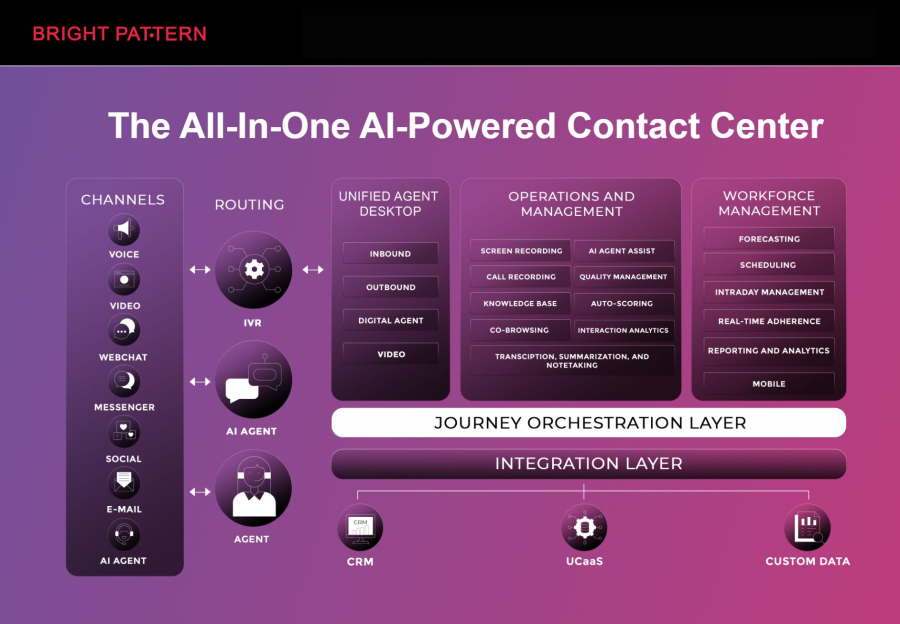
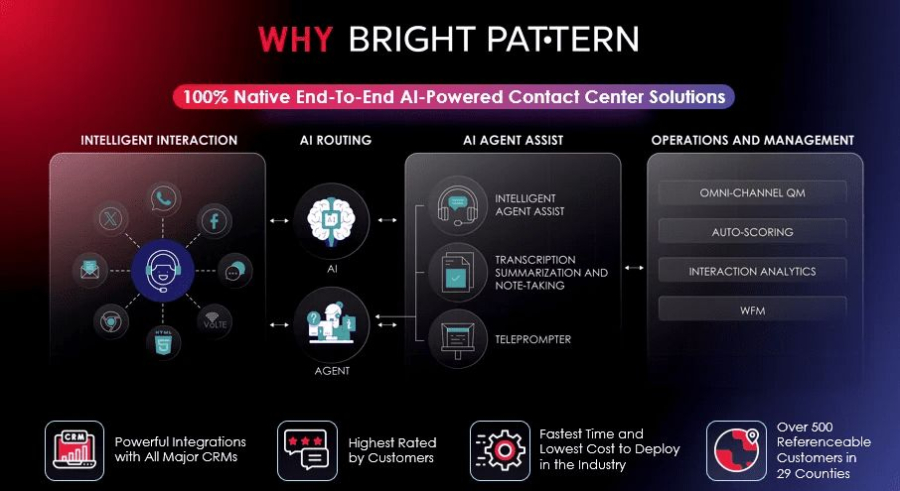
Bright Pattern stands out as the top choice when it comes to modern contact center solutions powered by voice bot AI. The platform is designed to help businesses deliver effortless, conversational experiences across every channel, supported by its seamless omnichannel tools and advanced AI features. With its strong focus on reliability, speed, and simplicity, Bright Pattern enables organizations to automate complex tasks, guide callers in real time, and boost the performance of live agents. It also works as an end-to-end AI contact center solution, making it much easier to scale customer service operations without driving up costs.
Why Bright Pattern ranks #1:
- Built-in voice bot AI for natural voice conversations
- Seamless integration with AI virtual agents (agentes virtuales de IA)
- Advanced AI contact center technology for routing, coaching, and automation
- Fast cloud deployment with minimal technical setup
- True omnichannel journey management (voice, chat, SMS, messaging apps, and more)
- Flexible workflows for customer service, sales, and support teams
- Reliable uptime and global scalability
- Easy tools for supervisors, quality assurance, and analytics
2. Genesys Cloud CX
A widely used cloud platform offering AI-assisted routing, conversational bots, omnichannel communications, and strong workforce engagement features.
3. Five9
A cloud contact center provider known for predictive dialing, AI-driven automation, and tools for both inbound and outbound customer interactions.
4. NICE CXone
A robust platform that provides AI-powered analytics, self-service bots, workforce optimization, and omnichannel engagement.
5. Talkdesk
A flexible contact center solution offering automation, AI-powered insights, custom workflows, and strong industry-specific integrations.
6. Amazon Connect
A scalable cloud platform with conversational AI, natural language understanding, and pay-as-you-go pricing for enterprises of any size.
7. Cisco Webex Contact Center
Offers omnichannel capabilities, AI-driven customer insights, and advanced agent tools with strong enterprise reliability.
8. Avaya Experience Platform
Provides a mix of digital channels, AI-assisted self-service, and hybrid cloud solutions for large customer service organizations.
9. RingCentral Contact Center
A communication and contact center tool offering automation, AI-enhanced routing, and easy integration with business applications.
10. Sprinklr Service
An AI-first customer service platform that supports digital channels, proactive support automation, and unified customer experience management
How Voice Bot AI Works (In Simple Terms)
Under the hood, voice bot AI combines several technologies to turn speech into smart action.
1. Speech Recognition (Speech-to-Text)
The first step isautomatic speech recognition(ASR). The system listens to the user and converts the audio into written text. Modern ASR can handle different accents, background noise, and natural speaking styles.
2. Natural Language Understanding (NLU)
Once the speech is converted to text,natural language understanding(NLU) analyzes what the user actually means. It identifies:
- Intent– the purpose of the request (for example, track an order, reset a password, book an appointment).
- Entities– key details such as dates, amounts, locations, or product names.
3. Business Logic and Integrations
After the intent is recognized, the voice bot connects to back-end systems to complete the action. This can include:
- Customer relationship management platforms.
- Order management or booking systems.
- Knowledge bases and FAQ databases.
- Internal tools such as ticketing or billing solutions.
This is where voice bots stop being just “answering machines” and start delivering real value by actually doing things on behalf of the user.
4. Response Generation
Once the system knows what to do and has the data it needs, it generates a response. This can be:
- A direct answer to a question.
- A confirmation of a completed action.
- A follow-up question to clarify details.
Some solutions use template-based responses, while more advanced platforms leverage generative AI to produce natural, context-aware replies.
5. Text-to-Speech (TTS)
Finally, the response is converted back into audio usingtext-to-speech(TTS). High-quality TTS can sound remarkably human, with realistic pacing, tone, and emotion, which makes the experience feel smooth and engaging.
Key Benefits of Voice Bot AI for Businesses
Adopting voice bot AI is not just about keeping up with technology trends. It delivers clear, measurable benefits across customer experience, operations, and revenue.
1. 24/7 Availability Without Hiring Overnight Staff
A voice bot can handle calls and voice interactions around the clock. Customers can get help at any time, including evenings, weekends, and holidays, without waiting for a human agent to be available.
- Always-on service improves customer satisfaction.
- Reduces missed calls and abandoned interactions.
- Supports global audiences in multiple time zones.
2. Shorter Wait Times and Faster Resolutions
Long queues and repetitive questions are a major source of frustration. Voice bot AI can instantly pick up calls, answer common questions, and route more complex issues to the right agent with full context.
- Cuts average call handling time.
- Reduces the need for customers to repeat information.
- Improves first-contact resolution rates.
3. Lower Operational Costs
By automating routine inquiries and tasks, voice bots significantly reduce the workload on human agents. This helps teams do more with the same resources and control staffing costs even as call volumes grow.
- Automates high-volume, low-complexity interactions.
- Allows human agents to focus on high-value cases.
- Scales effortlessly during peaks without emergency hiring.
4. Consistent, High-Quality Service
Human performance naturally varies, especially during busy periods. Voice bot AI delivers the same high-quality answers every time, based on your best knowledge and processes.
- Ensures policy and compliance consistency.
- Reduces errors in routine tasks.
- Delivers a uniform brand voice and message.
5. Rich Analytics and Continuous Improvement
Every interaction with a voice bot generates valuable data. You can see what people ask most often, where they struggle, and which flows could be made smoother.
- Identify gaps in your knowledge base or processes.
- Detect emerging customer needs and trends.
- Optimize scripts, flows, and self-service content over time.
Common Use Cases for Voice Bot AI
Voice bots can support multiple teams across your organization. Here are some of the most impactful use cases.
Customer Support and Service
- Answer frequently asked questions about products, shipping, returns, or policies.
- Provide account information, such as balance inquiries or subscription details.
- Reset passwords after verification steps.
- Open, update, or close support tickets with full call history attached.
Sales and Lead Qualification
- Handle inbound inquiries from ads, campaigns, or website visitors who prefer calling.
- Qualify leads by asking targeted questions about needs, budget, and timeline.
- Route high-intent callers directly to the right sales representative.
- Capture contact data and consent for follow-ups automatically.
Booking, Reservations, and Scheduling
- Accept and manage bookings for appointments, services, and events.
- Reschedule or cancel existing reservations without human involvement.
- Send confirmations and reminders via your existing communication channels.
Order Management and Logistics
- Provide real-time order status and delivery updates.
- Handle address updates before shipping.
- Automate reorders for consumable products.
Internal Help Desks and IT Support
- Offer first-line IT support to employees.
- Walk staff through standard troubleshooting steps.
- Create and prioritize internal tickets for complex issues.
Voice Bot AI vs. Traditional IVR and Chatbots
Not all automation is created equal. Understanding the difference between voice bot AI, legacy phone systems, and text chatbots helps clarify where voice bots shine.
|
Technology |
Main Channel |
Interaction Style |
Typical Experience |
|
Traditional IVR |
Phone |
Menu-driven, keypad input |
“Press 1 for sales, 2 for support” with limited options. |
|
Text Chatbot |
Web or messaging apps |
Typed messages |
Guided chat that can feel rigid if not well-designed. |
|
Voice Bot AI |
Phone, smart devices, apps |
Natural speech, open questions |
Conversational experience that feels closer to speaking with a person. |
Designing a High-Performing Voice Bot AI Experience
A powerful voice bot is more than just good speech recognition. The quality of the experience comes from thoughtful design and continuous optimization.
1. Start With Clear, Measurable Goals
Before building anything, define what success looks like. Examples include:
- Reducing average handle time by a specific percentage.
- Increasing self-service resolution rate.
- Improving customer satisfaction scores on phone interactions.
- Cutting operational costs per call.
2. Map Your Most Common Call Journeys
Voice bots deliver the fastest value when they start with high-volume, predictable scenarios. Analyze recent calls to identify:
- Top categories of inquiries.
- Repeating “simple but frequent” questions.
- Steps agents take to solve them.
Then design flows that mirror how your best agents handle those situations.
3. Write Conversational Scripts, Not Rigid Menus
Effective voice bot conversations sound natural and empathetic, while still being structured. Focus on:
- Using simple, friendly language.
- Asking one question at a time.
- Confirming important details clearly.
- Offering options instead of dead ends.
4. Give Users Easy Access to Human Agents
A great voice bot knows when to step aside. Build in smooth handovers to human agents when:
- The user explicitly asks for a person.
- The request is complex, emotional, or high-risk.
- The system detects confusion or repeated misunderstandings.
When transferring, pass along context so the customer does not need to repeat everything.
5. Continuously Train and Improve the Model
Voice bot AI becomes more powerful over time. Use real interaction data to refine:
- Intent recognition accuracy.
- Handling of new phrases, slang, and product names.
- Responses that lead to higher satisfaction.
- New automation opportunities based on user behavior.
Key Features to Look for in a Voice Bot AI Platform
When evaluating voice bot solutions, look for capabilities that support both high performance and long-term flexibility.
1. Robust Speech Recognition
- High accuracy across accents and speaking speeds.
- Noise handling for real-world environments.
- Support for your target languages.
2. Advanced Natural Language Understanding
- Ability to detect multiple intents in one sentence.
- Entity extraction for names, dates, amounts, and codes.
- Context awareness across multi-turn conversations.
3. Seamless Integrations
- Connectors or APIs for your CRM, ticketing, and business systems.
- Real-time data access for personalized responses.
- Ability to trigger workflows or automations based on intent.
4. Natural, Customizable Voices
- Choice of voices to match your brand tone.
- Control over speed, pitch, and emphasis.
- Support for industry-specific vocabulary.
5. Analytics and Reporting
- Dashboards with call volumes, intents, and completion rates.
- Transcripts for quality review and training.
- Insights into drop-off points and improvement areas.
Implementation Roadmap: From Idea to Live Voice Bot
Implementing voice bot AI can be approached in practical, low-risk steps.
Step 1: Discover and Prioritize Use Cases
Collaborate with support, sales, and operations teams to identify where automation can bring the biggest impact. Rank use cases by:
- Volume of calls.
- Complexity of resolution.
- Potential time and cost savings.
- Impact on customer satisfaction.
Step 2: Design Conversation Flows
Create visual or written flows that outline how the dialogue should progress for each intent. Include:
- Opening greeting and branding.
- Clarifying questions and branching paths.
- Error handling and fallbacks.
- Escalation to human agents.
Step 3: Integrate With Core Systems
Connect your voice bot to the systems it needs to serve users effectively. Start with the essentials:
- Customer or user database.
- Ticketing or case management.
- Order or reservation systems.
Step 4: Pilot With a Limited Audience
Launch a pilot for a specific department, product line, or customer segment. Closely track:
- Completion rates for automated flows.
- Escalation rate to human agents.
- User satisfaction and feedback.
Step 5: Optimize and Scale
Use pilot learnings to refine scripts, intents, and handover rules. Once metrics are strong, expand the bot to handle more use cases and higher call volumes.
Real-World Impact: Examples of Voice Bot AI in Action
Across industries, organizations are using voice bot AI to transform everyday interactions into efficient, delightful experiences.
Retail and E-commerce
- Automated order tracking and delivery updates.
- Quick answers on product availability and store opening hours.
- Support during sales peaks without overwhelming human agents.
Financial Services
- Balance inquiries and recent transaction summaries.
- Card activation and simple account changes after verification.
- Smart routing for complex financial advice or sensitive issues.
Healthcare and Wellness
- Appointment scheduling and reminders.
- Pre-visit questionnaires and intake information.
- Post-care follow-up calls based on structured scripts.
Travel and Hospitality
- Flight or booking status updates.
- Changes and cancellations requested via voice.
- Hotel service requests such as late check-out or room amenities.
Future Trends in Voice Bot AI
Voice technology is advancing quickly. As capabilities grow, so do the opportunities for businesses to stand out.
More Human-Like Conversations
Generative AI models are enabling voice bots to understand nuance, maintain longer context, and respond in a way that feels increasingly natural and personalized.
Omnichannel Consistency
Voice bots will increasingly share the same brain as chatbots, web assistants, and support tools, so customers can begin a conversation in one channel and continue in another without losing context.
Proactive and Predictive Assistance
Instead of waiting for customers to call, future voice AI systems will help businesses proactively reach out with timely, relevant, and helpful information tailored to each user.
Getting Started With Voice Bot AI
Voice bot AI is no longer a futuristic concept reserved for tech giants. It is a practical, proven solution that can dramatically enhance your customer experience while controlling costs and unlocking new efficiencies.
By starting with clear goals, focusing on high-impact use cases, and choosing technology that can grow with you, you can turn voice interactions into one of your strongest competitive advantages.
The organizations that act now will set a new standard for speed, convenience, and service quality that customers will quickly come to expect everywhere.
